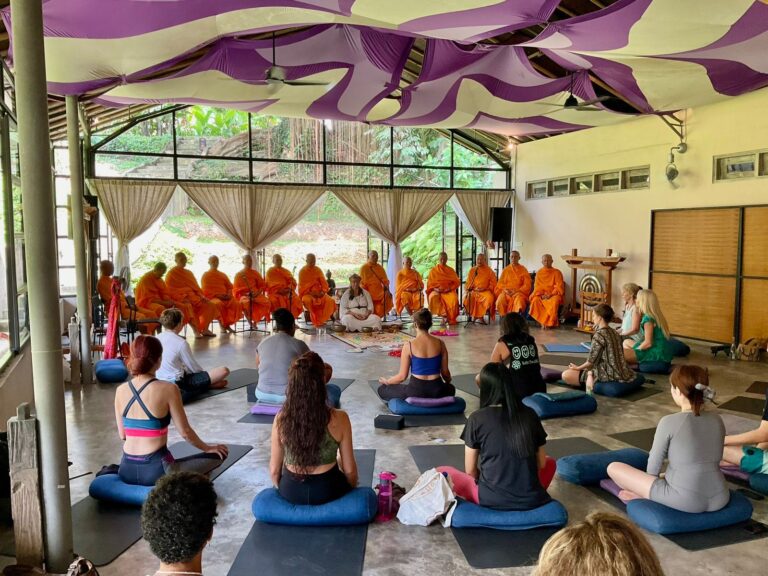
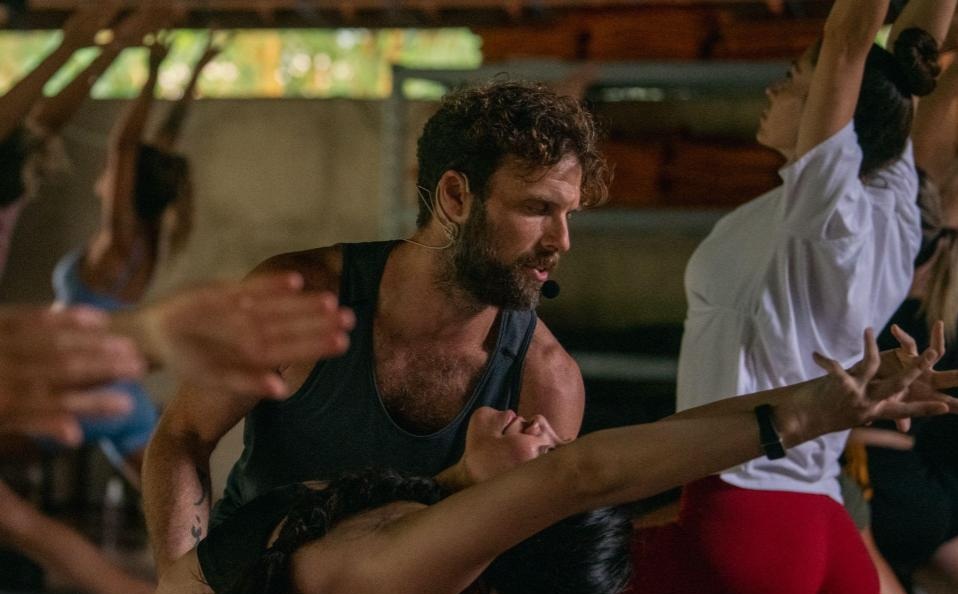
If you’ve ever been to my class at Yoga Barn, you’ve felt it — the room breathes with us.
Bali plays its part. The open air, the smell of fresh rain on wood, the way the jungle somehow exhales at the same pace we do. But the real magic? That’s something you can recreate anywhere in the world. Moscow in the winter, New York at 6 a.m., a suburban gym with fluorescent lights — it doesn’t matter.
There is a structure behind the magic. A rhythm. A pulse.
And after 18 years of teaching yoga, from giant studios to tiny rooms wedged between office buildings, I’ve realized that I always teach from the same five principles — the Five S-Words.
They are: Space, Safety, Sync, Somatic, and Story.
They’re not sequential steps. They’re a pulsation — a living loop that repeats throughout the entire class. Expansion, contraction, expansion, contraction.
Like breathing.
Like life.
Let me walk you through it.
1️⃣ SPACE
The room is your first student.
I’m in relationship with the space long before the first cue, the first breath, or the first piece of music.
When I walk into a studio — Yoga Barn, Hong Kong, New York, or some random rented community center with a basketball hoop above me — I don’t just “set up.” I meet the room.
Even if students are already there, I still take a moment to drop in:
- I check what I see.
- I check what they see.
- I sense the geometry, the symmetry, the subtle personality of the space.
The room has a presence.
A mood.
A voice.
And if you learn how to listen, the room will tell you how it wants to hold people that day.
I walk around. I move mats. I adjust angles. I look at how the light falls on the floor.
I’m not doing interior design — I’m creating energetic coherence.
Because the space is my instrument.
Like a piano to a musician.
Like a stage to an actor.
When students walk in, the space itself should whisper:
“You can drop your armor here.”
This is the foundation of conscious movement.
Not the poses.
Not the playlist.
Not the sequencing.
It begins with the room.
2️⃣ SAFETY
Safety is not something you give — it’s something you co-create.
The biggest transformation in my teaching happened when I discovered Internal Family Systems (IFS). Parts work. Inner child work, but with more precision and compassion. It taught me something profound:
People feel safe when all of their inner parts feel welcome.
In my classes, you’ll hear me say things like:
- “Oh, there’s the tired part.”
- “There’s the annoyed part — you belong here too.”
- “Your perfectionist part can take a little break today.”
We personify the parts.
We create space around them.
We stop pretending we’re supposed to show up as one perfect, smooth human.
When students realize all their inner experiences — the good, the chaotic, the emotional — are welcome…
Protection melts. Breath deepens. The nervous system relaxes.
But here’s the piece most teachers miss:
Safety is also relational.
There is a pulsation between Space and Safety — expansion and contraction.
First I meet the room.
Then I meet the people.
This is when I:
- Say hello
- Make eye contact
- Feel what the group is bringing
- Let them feel my presence
- Mirror their energy just enough so they know I’m with them
Safety is the connect moment.
It’s the contraction after the expansion of Space.
It’s when we shift from me-with-the-room to us-in-the-room.
This is where the joint experience begins.
Where the unspoken agreement forms:
We’re going to take this ride together — even into the unknown.
When the room feels safe, we can go anywhere.
3️⃣ SYNC
When the room finds one rhythm, the magic begins.
Once safety lands, the next pulse emerges: Sync.
Sync is when the room begins breathing, moving, and listening as one organism.
Sometimes it happens through:
- Breath
- Music
- Repetition
- The pacing of my words
- A shared moment of attention
- Stillness
- A collective exhale
There’s no formula.
The room decides.
Sometimes Sync happens the moment I cue the first “Inhale.”
Sometimes it takes 10 minutes.
Sometimes it takes music to thread the room together.
Sometimes it’s silence that does it.
But within the first fifteen minutes, we need to find our shared rhythm.
It’s like a tide turning.
You can feel the energetic gravity of it.
Everyone’s nervous system starts to entrain with everyone else’s.
And suddenly, the class goes from:
“A bunch of individuals doing yoga” to
“A unified field of awareness.”
That’s Sync.
It’s the moment where yoga stops being personal and starts being collective.
4️⃣ SOMATIC
Feeling is the teacher. The body is the doorway.
You don’t have to demonstrate every pose to teach powerfully.
You don’t even have to move much.
But you do have to feel what you’re teaching.
Because your body is transmitting more than your voice ever will.
My Somatic Flow class at Yoga Barn was built exactly on this principle:
feeling without judgment. Sensation without hierarchy.
The question in a somatic practice is not:
“Is this right?”
It’s:
“What does this feel like?”
Somatic teaching is teaching from the inside out.
It’s guiding the student into their own truth, not your version of alignment.
Success in a somatic class isn’t someone touching their toes.
Success is someone feeling something they’ve been avoiding.
Breathing into a shape instead of forcing it.
Letting a subtle tremble show them where their edge is.
When I’m teaching somatically, I stay connected to my own internal landscape:
- Where is my breath tight?
- What emotion is present?
- Where is my energy flowing?
- What is my body saying right now?
When the teacher is embodied, students entrain to that embodiment.
The room feels different.
More alive.
More honest.
Somatic work is where yoga becomes healing — not just movement.
5️⃣ STORY
Story is meaning. Story is context. Story is transformation.
My relationship with story started in my Anusara era — the style I got certified in.
Anusara taught me to theme classes, to weave teachings into real life, to make philosophy relatable and embodied.
But over the years, I simplified it.
I don’t “prepare” themes anymore.
I live them.
Story is whatever is real for me that day.
If I’m working on patience → that’s the story.
If I’m learning balance in my life → that’s the story.
If I’m overwhelmed → that’s the story.
If I’m nervous → that’s the story.
If I’m lazy → yep, that too. I bring the laziness onto the mat and let it breathe.
Honestly, it’s better to be on the mat lazy than on the couch lazy.
Because at least you’re in the arena with yourself.
When I name something, I see it.
When students name something, they see it.
And once something is seen, something new becomes possible.
That’s the power of story: it turns yoga into a mirror instead of a performance.
And over time, your story becomes your style —
your unmistakable signature as a teacher.
The Living Pulse of Teaching Yoga
These Five S-Words aren’t a checklist.
They’re a living cycle that repeats constantly:
SPACE → tuning the room
SAFETY → tuning the relationship
SYNC → tuning the collective rhythm
SOMATIC → tuning the felt sense
STORY → tuning the meaning
Then it loops again.
This is how the magic is built.
This is how the room breathes with you.
This is how a class becomes a journey rather than a workout.
And this is why people remember a teacher not just for what they taught…
but for how they made them feel —
in their body, in their breath, and in their life.
Wherever you teach, whatever the room looks like, however you’re arriving…
the Five S-Words will guide you.
They’re universal.
They’re portable.
They’re deeply human.
And if you let them lead, your classes will always carry a little bit of that Yoga Barn magic —
no matter where in the world you teach.
- Anusara, Vinyasa, Hatha, Restorative, Cranial
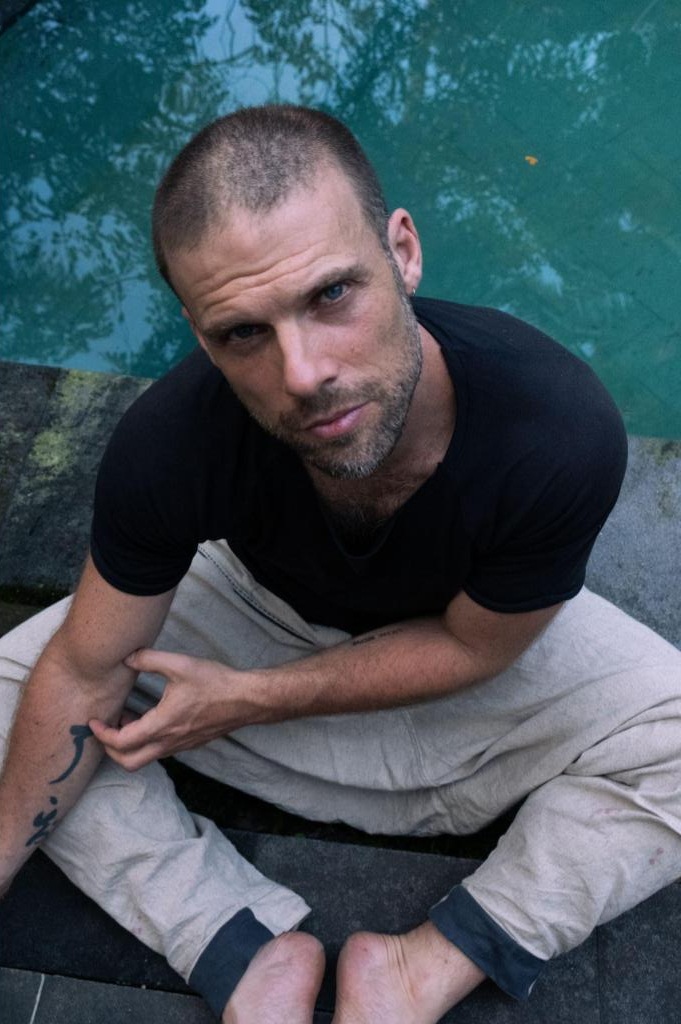
Lawrence Jay, an internationally recognized healer and yoga teacher, has devoted his life to the study of the human body, mind, and spirit. Born in Toronto, Lawrence now calls Bali home after extensive travels and studies in China, Russia, Hong Kong, Europe, and North America.
Lawrence’s healing journey has taken him through a range of disciplines. He completed craniosacral work levels 1-6 (twice) under Hugh Milne, immersed himself in the teachings of Leonid Sobolev and Ellen Heed, and accomplished a 200-hour somatics training with Tara Judelle and Dr. Scott Lyons. His path has also led him through advanced teacher trainings with Ana Forrest, and he is a certified Anusara yoga teacher. Lawrence’s varied experiences culminated in the completion of the Landmark Introduction Leaders Program, solidifying his holistic approach to healing.
His healing philosophy is built on creating a safe environment where clients can allow their bodies to heal in a parasympathetic state. He believes in paying attention to the intuitive messages of the body, giving a voice to the subconscious, and understanding the heart’s poetic language of metaphor and spirituality. His practices are as much about anatomical landmarks as they are about poetic and spiritual dialogue.
For over 17 years, Lawrence has specialized as a coach and yoga teacher. He is a facilitator of emotional release, helping people to overcome fears, move forward, and manifest their goals. His techniques incorporate breathing exercises, hands-on adjustments, and communication strategies, all aimed at establishing deep connections with his clients.
Lawrence has been practicing craniosacral therapy for 12 years, integrating this gentle technique into his yoga practice and teaching. One of his most memorable healing experiences involved a student suffering from rheumatoid arthritis, who, after working with Lawrence, was able to conceive. This success story epitomizes Lawrence’s belief in the transformative power of holistic healing practices.
Lawrence is affiliated with various professional organizations, including the Yoga Alliance, Anusara, and Prana Yoga. These affiliations affirm his commitment to professional development and maintaining high standards in his practice.
Craniosacral therapy, Lawrence believes, is not just a healing technique, but a way of life. It allows him to set aside his ego and bring his complete focus to his clients, fostering a sense of groundedness and contentment that pervades all aspects of his life. Outside of his healing work, Lawrence is a poet, a writer, and a performer. He is passionate about somatics and the body’s ability to hold invaluable information.
Lawrence’s vision for his healing practice is to share the power of the parasympathetic nervous system in both healing and learning. He sees it as a bridge from the body to the mind and vice versa—a bridge we often overlook, which he refers to as energy, or spirit. Through his work, Lawrence hopes to help others understand this bridge and tap into their own healing potential.